
Resistance, Self-Doubt, and the Discipline to Keep Going:
a Conversation with Steven Pressfield

There is a moment in almost every meaningful pursuit when doubt begins to speak louder than belief. The work gets harder, progress slows, and the excitement that once made everything feel possible begins to fade. That is often when the questions arrive: Am I good enough? Is this actually going anywhere? Should I keep going?
For Steven Pressfield, those questions were never theoretical. Long before The War of Art became one of the most influential books on creativity and discipline, Pressfield spent years trying to understand his own path. He worked 21 jobs across 11 states, struggled to find success as a writer, and admits that he continued for years without fully believing in himself.
That may be one of the most important ideas to come out of his conversation: you do not necessarily have to believe in yourself before you begin. Sometimes, you simply have to keep going.
What If Self-Belief Comes Later?
We often hear that success begins with confidence. Believe in yourself. Bet on yourself. Trust the process. Pressfield’s story is more complicated than that. He kept pursuing writing for years despite having very little evidence that it would work. He looked at his own work and questioned whether it was any good. External validation was almost nonexistent. Still, he continued.
That distinction matters because confidence can help us move forward, but Pressfield’s experience suggests that confidence does not always have to come first. Sometimes action comes first, followed by experience, competence, and eventually belief. Later in the conversation, when Andro suggests that self-belief helps us push through Resistance, Pressfield gently challenges the idea: “Even without the self belief, you have to keep going.”
There is something freeing about that perspective. It removes the expectation that we need to feel completely certain about ourselves before pursuing something meaningful. Confidence can fluctuate. Motivation can disappear. There may be entire seasons when the results provide little reason to believe things are working. Pressfield’s story suggests that the more important question is whether we can continue doing the work when those feelings are absent.
Resistance: The Battle We Rarely See
Pressfield gave the force that often stands between us and that work a name: Resistance.
Resistance is the defining idea behind The War of Art, and during the interview, Pressfield describes it as the force that appears whenever we begin moving toward something meaningful.
“As soon as you start to move toward it, it pushes back,” he explains. It can take the form of procrastination, distraction, fear, self-doubt or avoidance.
Part of what makes Resistance so difficult to recognize is that it rarely announces itself dramatically. It can sound perfectly reasonable. Tomorrow might be a better day to start. Maybe you need more preparation. Maybe you are not ready yet. Maybe someone else could do it better. The thoughts themselves can feel rational enough that we never stop to question where they are coming from.
Pressfield’s philosophy offers another way to interpret them. Instead of automatically believing every thought that tells us to stop, we can learn to recognize the voice of Resistance for what it is. During the conversation, he explains that when Resistance tells you that you are too young, incapable or unlikely to succeed, the truth may be the exact opposite. That does not mean every dream is guaranteed to work. It means fear does not automatically deserve the final word.
Even self-doubt can take on a different meaning through that lens. Pressfield tells Andro that “self-doubt can be a really positive thing if you think of it as the voice of Resistance.” Once you recognize it that way, he says, “Whatever it’s saying to you, it’s lying.”
Perhaps the most useful part of that idea is not that we should ignore every doubt we have, but that doubt itself does not automatically mean we are moving in the wrong direction. Sometimes the closer we get to work that matters to us, the more Resistance we feel toward doing it.
The Years That Seemed To Lead Nowhere
One of the most interesting questions in the conversation comes when Andro asks Pressfield whether his years of setbacks were delaying his purpose or preparing him for it. Pressfield chooses the latter.
Looking back, he sees those years as an education. They gave him experience and perspective that he could not have gained otherwise. During his time as a screenwriter, for example, Pressfield spent years learning how stories work, even though that chapter was not ultimately where his career would remain.
That offers a different way of thinking about seasons that seem unproductive. A job that does not become your career, a project that fails, a partnership that ends or an opportunity that never materializes does not automatically become meaningful simply because it happened. But it can become useful if you allow yourself to learn from it.
Pressfield’s career is full of those moments. After a professional partnership ended abruptly, he found himself terrified that he had destroyed his career. He gave himself a year to write two screenplays on his own. Both eventually sold, helping him establish himself independently. What initially felt like an ending became a transition.
How Do You Know What You’re Meant To Do?
Pressfield does not romanticize writing. He does not describe sitting down to work as effortless or endlessly joyful.
When Andro asks when he realized writing was something he was meant to do, Pressfield returns to a small moment from years earlier. After spending hours writing material he thought was terrible, he went into the kitchen and began washing dishes. Then he noticed something unusual: he was whistling.
The writing had not made him successful. It had not produced anything he thought was worth publishing. But it had centered him. Years later, he still points to that moment as the time he began to understand that writing belonged in his life.
That distinction is worth sitting with. A calling may not always be the thing that feels easiest. It may not even be the thing we enjoy every second of doing. Sometimes it is the thing that leaves us feeling most aligned once we actually do it.
Pressfield says writing never feels like “a job” because he would do it for free, but he is equally clear that it requires effort and discipline. Meaningful work can be meaningful and difficult at the same time.
If Resistance explains why we hesitate, Pressfield’s idea of the Professional explains how we respond.
“The professional shows up every day,” he tells Andro. For Pressfield, professionalism is less about whether someone gets paid and more about the habits they develop around their work. He describes amateurs as having amateur habits and professionals as having professional ones.
That reframes professionalism as a relationship with the work rather than a title. An amateur may depend on inspiration or motivation to begin, while a professional develops the discipline to return regardless of how they happen to feel that day. Eventually, almost any meaningful pursuit forces us to confront the gap between what we feel like doing and what we have committed ourselves to doing.
The professional does not necessarily experience less Resistance. The difference is that Resistance no longer gets to make the decision. You show up, do the work, and return tomorrow.
Becoming a Professional
The Arcadian: An Idea That Wouldn’t Let Go
Pressfield’s newest book, The Arcadian, offers another window into his creative process. Its central character, Telamon of Arcadia, first appeared in his work roughly two decades ago and continued returning as Pressfield’s understanding of him evolved.
Pressfield describes Telamon not as an alter ego, but as a character who possesses qualities he admires—someone capable of things he may not feel capable of himself. When asked what he would want someone unfamiliar with The Arcadian to know, Pressfield says the story goes into “some deep areas” and can serve as an introduction to his work.
There is something fitting about a character refusing to leave the imagination of a writer whose career has been shaped by persistence. Sometimes creative ideas keep returning until we finally give them the attention they demand.
Toward the end of the conversation, Andro asks Pressfield what he believes today that his younger self might have disagreed with.
Pressfield says his younger self may have believed that anyone could become anything. Today, he sees it differently. He believes people are born with particular strengths and a particular calling, and that part of life is discovering what that is and committing to it.
Whether or not someone agrees with that philosophy, it raises a worthwhile question: What work keeps calling you back, even when Resistance gives you every reason to walk away?
Pressfield’s own story does not offer the comforting promise that finding your calling will suddenly make the path clear. His experience suggests almost the opposite. You may question yourself. You may encounter Resistance. You may spend years without the validation you hoped would tell you that you are on the right path.
And you may still be on it.
What Keeps Calling You Back?
Near the end of the conversation, Pressfield discusses losing his home in a fire. The experience was harder than he expected, and one of the things that helped hold him together was the work. He continued writing and gives himself credit simply for maintaining momentum through a period that could easily have broken it.
That detail gives additional weight to the final question of the interview. What would Steven Pressfield tell someone who is showing up, facing Resistance, doing everything possible to make a dream happen, and still seeing no evidence that anything is changing?
His answer is simple:
“Don’t quit.”
Maybe that is the larger lesson of the conversation. Not that belief will always be there. Not that success is guaranteed. Not that every obstacle is secretly preparing you for something better. But uncertainty, fear, Resistance, and failure do not necessarily mean you are finished.
Sometimes, the very things making you question the path can appear as you move closer to work that means something to you. And when the voice telling you to stop gets louder, you do not have to automatically turn back.
Keep Going
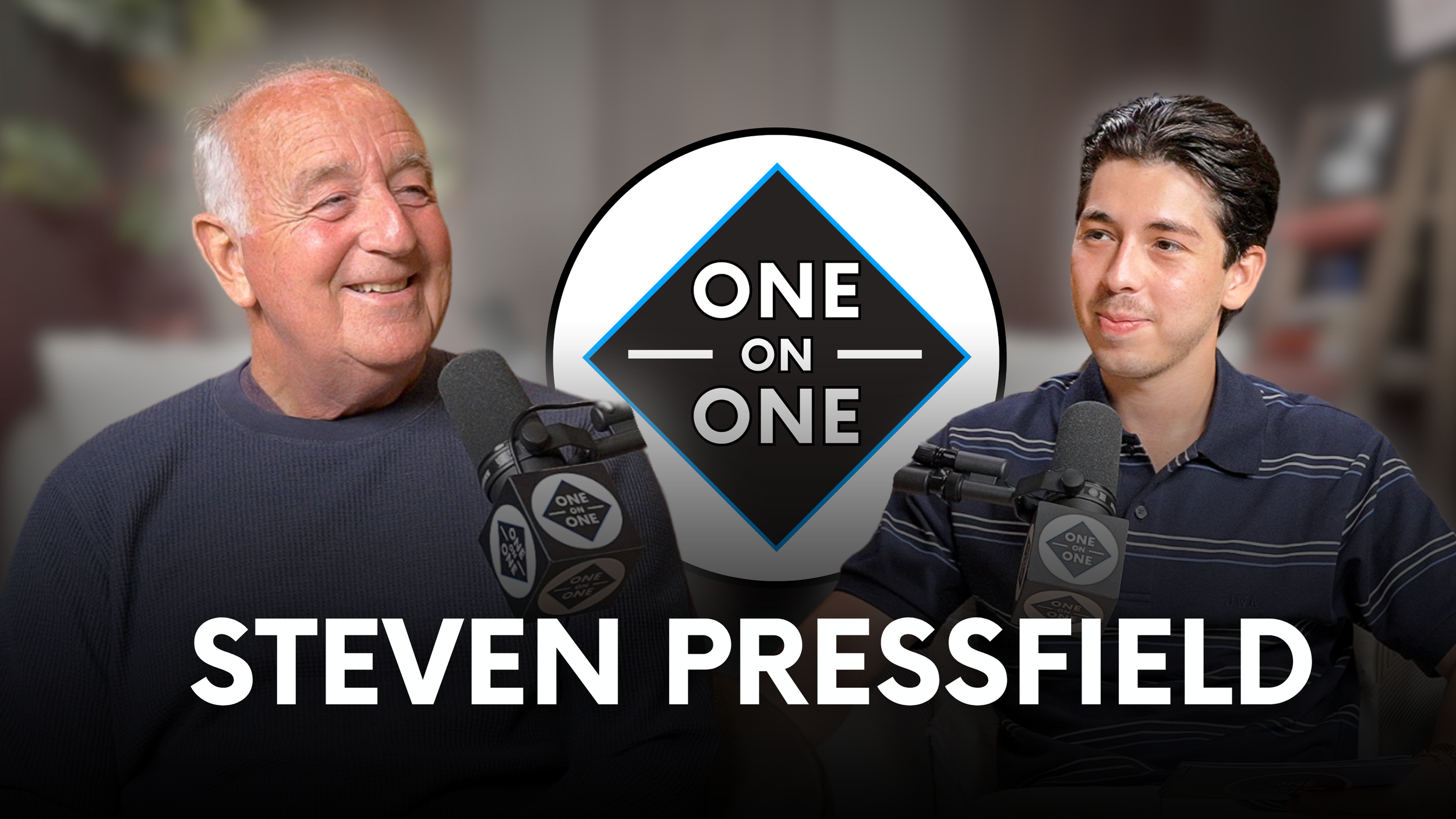
Watch the Full Conversation
This conversation with Steven Pressfield is ultimately about much more than writing or creativity.
It’s about what happens when the path you believe in gives you very little reason to believe in yourself. It’s about learning to recognize Resistance, continuing through uncertainty, finding the work that keeps calling you back, and developing the discipline to show up even when motivation and confidence disappear.
Pressfield’s own story is proof that the road toward meaningful work is rarely a straight one. He spent years questioning himself, experiencing setbacks, and wondering whether his work would ever lead anywhere. Yet he continued. And through those years, he developed a philosophy that has since helped countless people understand the invisible battle between what they want to pursue and what keeps them from pursuing it.
Most of all, this conversation is about what it means to keep going before you know how the story will end.
We invite you to watch the full conversation with Steven Pressfield and hear his story, lessons, and perspective in his own words.
Some conversations give us answers.
Others leave us asking better questions.
We believe this is one of them.